
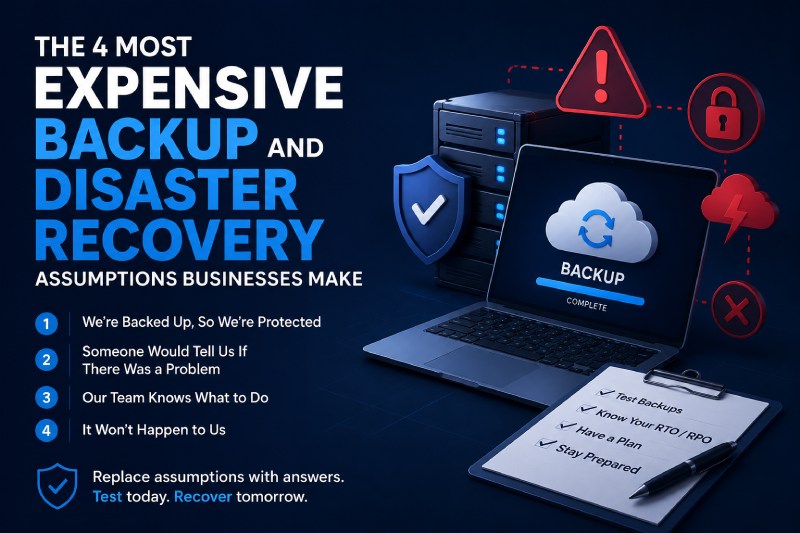
The 4 Most Expensive Backup and Disaster Recovery Assumptions Businesses Make
Just because you have backups doesn’t mean your business can recover from ransomware, hardware failure, accidental deletion, or a major outage.
The real question is: What happens when you actually need those backups?
Mike Tyson famously said, “Everyone has a plan until they get punched in the mouth.”
For a business, that punch might be a failed server, a ransomware attack, a cloud outage, a compromised account, or a backup that doesn’t restore as expected.
Assumptions can seem like facts until they’re tested. Here are four you should challenge before an outage forces you to.
Assumption #1: “We’re Backed Up, So We’re Protected”
Seeing successful backup reports and green checkmarks is reassuring, but they don’t answer the most important question.
Can you actually recover?
A successful backup means your data was copied. A successful recovery test shows whether that data can actually get your business running again.
Leadership should know two important measurements:
Recovery Time Objective (RTO): How quickly does a critical system need to be restored?
Recovery Point Objective (RPO): How much data can the business afford to lose between its last usable backup and the disruption?
Instead of just knowing you’re “backed up,” you should know when recovery was last tested, what was restored, and how long it took.
The riskiest backup is often the one you’ve never tested.
Assumption #2: “Someone Would Tell Us If There Was a Problem”
Monitoring tools can spot problems, but finding an issue isn’t the same as fixing it. A weather alert can warn you about a hurricane, but it won’t board up your windows.
A strong IT response process should answer four questions:
Detect: Who sees the alert?
Escalate: Who takes responsibility?
Respond: How quickly does someone act?
Resolve: Who owns the problem until it’s actually fixed?
Monitoring gives you visibility. Adding an accountable response process turns that visibility into action.
Assumption #3: “Our Team Knows What to Do”
Imagine a critical application goes down at 4:45 p.m. on Friday.
Who takes charge? Who calls IT? Which systems need to come back first? Should employees keep working? Who talks to customers? A disaster is the worst time to figure these things out.
A practical recovery plan should define five stages:
Detect → Contain → Prioritize → Recover → Verify
Your employees don’t need to be IT experts. They just need to know their roles, who makes decisions, how to escalate issues, and which systems are most important. Often, the actual chaos comes from not knowing what to do next, not just from the outage itself.
Assumption #4: “It Won’t Happen to Us”
Business disruptions don’t always look like dramatic cyberattacks.
Hardware can fail. Employees might accidentally delete files. Internet connections can go down. Cloud services experience outages. Accounts can get compromised. Vendors can run into issues, too.
You can’t predict every disruption, but you can be ready to recover from one.
Instead of asking, “Will something happen?”, ask:
“What business functions need to come back first, and how quickly can we restore them?”
That’s when backup planning turns into business continuity planning.
Put Your Recovery Plan to the Test
Downtime isn’t just an IT issue. It means employees can’t work, customers can’t get answers, transactions can’t go through, and leaders spend valuable time managing an outage instead of running the business
That’s why recovery time matters for the whole business, not just for IT.
A useful recovery test should:
1. Prioritize your most critical systems.
2. Restore selected systems or data from backup.
3. Verify that the restored systems actually work.
4. Measure expected recovery time against the real result.
5. Improve and retest anything that didn’t perform as expected.
Finding problems during a recovery test isn’t a failure. Discovering them before a real outage is exactly the point of testing.
Replace Assumptions With Answers
You don’t need to be an IT expert to ask the right questions.
Start with these:
When was our last successful recovery test?
What did we actually restore?
What is our RTO and RPO?
How long did the recovery take?
What problems were discovered?
Were they corrected and retested?
If no one can give clear answers, you might have backups but not a proven recovery process.
7th Di Technologies helps businesses take a proactive approach to IT, cybersecurity, backup, recovery, and business continuity.
If you’re not sure your critical systems could recover in the time your business needs, set up a discovery call with us. We’ll help you see what’s being backed up, what’s been tested, and where there might still be gaps.
The goal isn’t to worry about the next outage. It’s to replace assumptions with real answers. When disruption happens, you don’t want to be figuring out your recovery plan for the first time.
You want to execute one that’s already been proven.